INTRODUCING THE DATA DASHBOARDS
The Office of the DeKalb County District Attorney is committed to transparency and accountability, as well as victim-centered and data-informed prosecutorial decision-making.
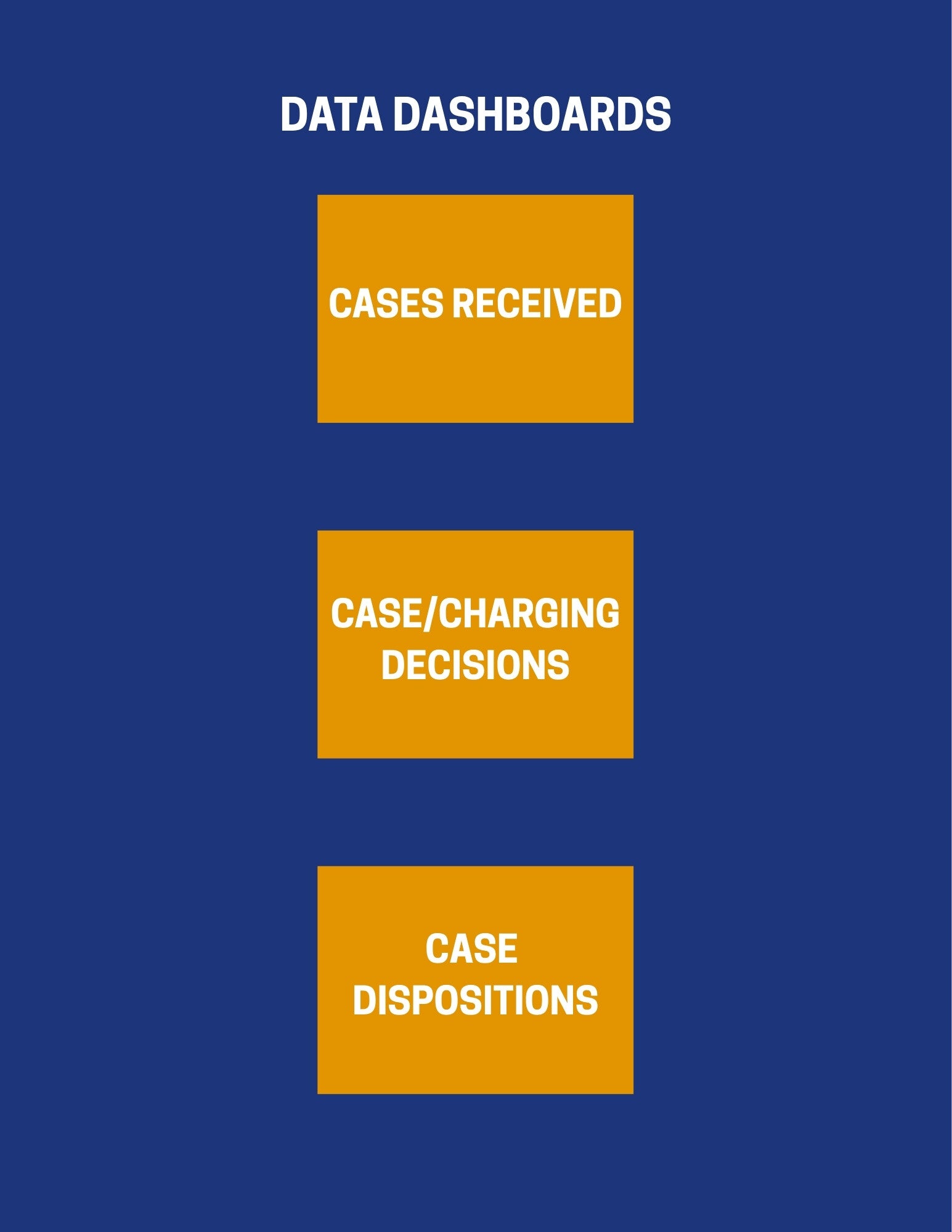
These data dashboards are designed to inform the public about how many cases the office receives annually and where those cases are assigned within the office and within the court system.
The DA's Office prosecutes cases in both the DeKalb County Superior Court (DeKalb Judicial Circuit) and the DeKalb County Juvenile Court. These dashboards only contain data related to felony criminal cases prosecuted in Superior Court.
In the DeKalb County Superior Court, a felony criminal case typically begins with an arrest, at which point the DA's Office receives the case file from the arresting agency. This is followed by a secondary investigation by the DA’s Office, after which prosecutors decide whether to charge, dismiss, divert, or transfer a case based on the facts and admissible evidence. If formally charged, the case against the defendant proceeds to an arraignment, followed by pre-trial motions hearings, and ultimately, a trial (if no plea or dismissal occurs).
A brief summary of each data dashboard is presented below. To navigate directly to a dashboard and view all related charts, click one of the following links:
For further details, including instructions on how to navigate the dashboards and data definitions, please refer to the County Information and Background Information tabs.
CASES RECEIVED
After a law enforcement officer makes an arrest or obtains an arrest warrant for an individual accused of committing a felony offense in DeKalb County, the case is referred to the Office of the DeKalb County District Attorney. The DA’s Office then formally opens a case, and it is assigned a case number. Each person charged is considered a single case received. In other words, an incident in which four people are accused will count as four separate cases.
In many cases, an accused is arrested on multiple criminal charges. In these dashboards, each case is categorized by the highest-level felony offense, regardless of any other charges filed in that case. For example, a case where an individual is accused of Felony Murder (Homicide), Aggravated Assault (Assault and Battery), and Possession of a Firearm or Knife During the Commission of a Felony (Weapons) would fall under the Homicide section. To review the offense groups ranked in order, please visit the Technical Notes section.
CASE/CHARGING DECISIONS
After the Office of the DeKalb County District Attorney receives a case from a law enforcement agency, it is assigned to an Assistant District Attorney, a POST-certified (Georgia Peace Officer Standards & Training Council) District Attorney Investigator, and a Victim Advocate. The DA Investigator conducts a second, independent investigation. Based on that investigation and in consultation with the victim, the office decides whether there is sufficient evidence to prosecute the accused and what charges to file. Possible case review outcomes include:
- formal charging, where prosecutors present the case to the Grand Jury for indictment or file a formal accusation;
- an offer to the accused to enroll in an appropriate diversion program;
- dismissal, where the office declines to prosecute based on the evidence and the case is closed, though it could be reopened later if new evidence emerges; or
- transfer, where the case is transferred to the appropriate venue, such as State Court, Juvenile Court, or Federal Court.
It is important to note that the following chart represents decisions made in a specific year; however, based on the length of the investigation, these cases may not have been received in the same calendar year the decisions were made.
In 2023, following a return to normal in-person operations at the courthouse after the COVID-19 pandemic, the DA's Office worked with the DeKalb County Clerk of Superior Court to input case disposition data that had previously been out-of-date.
CASE DISPOSITIONS
A criminal case prosecuted to its conclusion has several possible outcomes or dispositions:
- conviction (accused found guilty by plea or trial)
- acquittal (accused found not guilty by trial)
- dismissal, including as a result of the successful completion of a diversion program
The following chart highlights the number of dispositions by type and the number of dispositions per Superior Court Judge/Division annually.
Please note that the average case length from arrest to disposition is more than one year; therefore, many cases closed in the year reported were received by the DA's Office in a prior year.
Every two years, one Superior Court Judge is selected to serve as Chief Judge. The Chief Judge carries a reduced caseload to allow sufficient time for administrative duties. In 2023 and 2024, the Honorable LaTisha Dear Jackson served as Chief Judge. In 2025 and 2026, the role was filled by the Honorable Shondeana C. Morris.
Office of the DeKalb County District Attorney
Sherry Boston, District Attorney